13.3.21

Entrevista: Senadores de oposición piden reemplazar monumento a Baquedano por uno a Gabriela Mistral

 Publicación original en  Veritas Capitur

A raíz del retiro del monumento al General Manuel Baquedano de la plaza homónima, los senadores Jaime Quintana (PPD) y Yasna Provoste pidieron reemplazarlo por uno en honor a la poetisa chilena Gabriela Mistral.

Esto reflota un proyecto de ley presentado por los mismos parlamentarios en noviembre del 2020, en donde solicitan un monumento en memoria de la Premio Nobel de Literatura, específicamente en el lugar rebautizado como Plaza de la Dignidad.

El senador Quintana explicó que “las sociedades cambian y probablemente hoy las hazañas militares no son lo más convocante”.

“Creemos que en un centro neurálgico debiera estar Gabriela Mistral, mujer destacada en todo el mundo, primera iberoamericana en recibir un Premio Nobel y una figura mucho más conectada con la ciudadanía del siglo XXI”, argumentó el senador.

Al mismo tiempo, se abre un debate sobre qué figura podría eventualmente reemplazar a la estatua del General Baquedano. El propio senador Quintana realizó una encuesta en su cuenta de Twitter preguntando quién debería estar conmemorado en un nuevo monumento.

En medio de esta discusión, la arquitecto e investigadora en intervenciones de espacios públicos, Beatriz Maturana, lamentó la remoción del monumento a Baquedano.

21.10.20

La ciudad: ¿escenario de convivencia ciudadana o moneda de cambio para la extorsión?

Architects for Peace's president, Beatriz Maturana recently published an article from the city of Santiago. The letter appears in El Libero and El Mercurio (22.10.2020), deals with the role of the professions of the built environment in the social unrest. Political parties and institutions from the left and center-left supported the uprising of 18th of October 2019, the Estallido Social. The center-left had governed for 24 of the last 30 years and lost office to the second center-right government in 2018. The Estallido Social is distinguished by its unprecedented level of violence and destruction of urban infrastructure, architecture and built heritage. This protest forced an agreement for a plebiscite to approve or reject a new constitution together with an agreement for peace. The Plebiscite is next week but peace never came. A year later, the violence that looted, burnt and destroyed the entire Metropolitan transport system, medical centres, schools, universities, hotels, businesses, supermarkets and churches had spread across the country. In the rural south, homes continue to be burnt. Marking one-year, protesters destroyed with arson attacks two historic churches in central Santiago. They had both been partially destroyed when the crisis began in October 2019. The crowd of young protesters applauded and screamed as the burning church spire fell.

Beatriz has lived and worked in many parts of the world but has not witnessed a citizenry destroying its own built heritage or seen young people being manipulated by falsehoods. Chile has the highest Human Development Index in Central and South America.

Architects for Peace was formed because cities are where over half the world’s population lives and are the target of contemporary wars and civil conflict. In Chile, there is no professional body that represents the professions of the built environment which is speaking against the violent destruction of Chilean Cities, of its capital, Santiago.  
 
Image source unknown, mostly from local media.

25.9.20

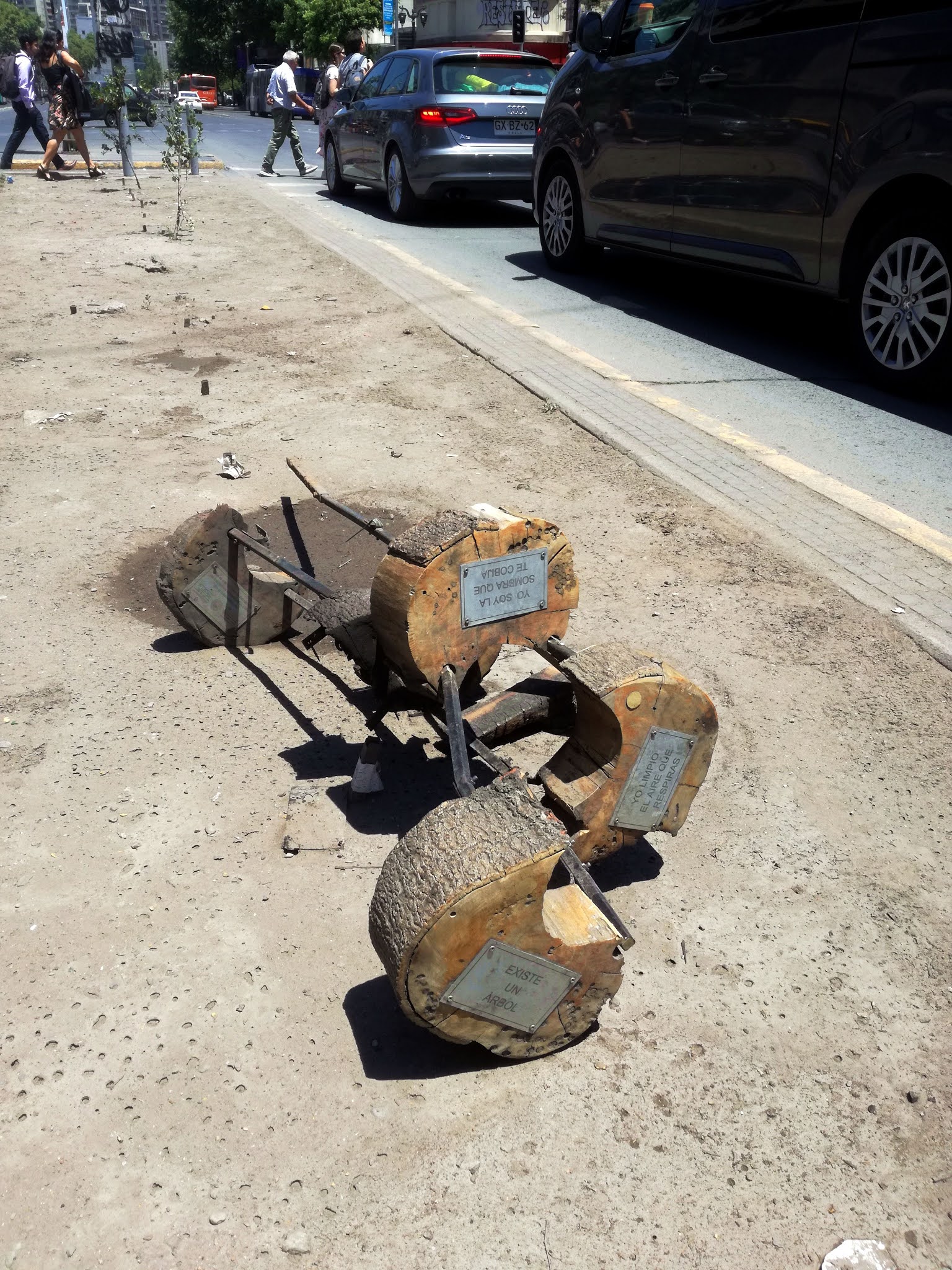
Un árbol resiste


La cordillera quiere mostrar su sublime esplendor, pero no la vemos. Los minutos corren y quisiéramos correr con ellos, pero el semáforo de la Alameda—hoy restaurado—, sigue en rojo. Esa Alameda por la que alguna vez bajó el aire fresco, el verdor y una distante calma. La belleza de la cordillera nos alcanza momentáneamente, sólo después de alguna lluvia torrencial, entonces por unos segundos algunos miramos al oriente, para retornar rápidamente y alcanzar el otro lado de la calle.


Cerca del semáforo el lánguido árbol resistió y nos observa, pero no lo vemos. Él, más agredido que nosotros, trata de sobrevivir a la contaminación, al menosprecio y el ruido, pero no puede sobrevivir a la brutalidad humana, ni a la furia y destrucción desatada por algunos violentistas. Cada dos meses, el árbol caía a pedazos y en el mismo lugar era remplazado por otro similar. Hoy, largo y enclenque, languidece y nos vuelve a mirar, pero no lo vemos.

Un árbol, ese que nos humaniza, que nos recuerda que existe vida entre tanto cemento, máquinas, maldad y ansiedad, este árbol sobrevivió por varios años, protegido por una coraza construida por mis estudiantes. Este árbol se acorazó con una corteza antigua de experiencia y de tiempo. Este árbol nos mira, incrédulo y aún incierto de su futuro. Hoy sin los pedazos de su  coraza, la que alcancé a rescatar de ser vendida para alimentar el fuego de las barricadas.

27.7.20

Urban Transformations in the Culture of Santiago's Barrios

Authors: Beatriz Maturana, Anthony McInneny, Marcelo Bravo
Open House International
2019

Abstract: Within Santiago, Chile’s capital city, Barrio is a fundamental urban concept: an identity of place that defines a social space more than the territorial boundary of a designated area. Nearly 30 years of sustained, economic growth have positioned Chile, and Santiago with 40% of the country’s population, as a tourist, financial and investment centre for South America. After a general decline of the inner-city area during the time of dictatorship (1973-1990), three innercity residential barrios are being re-defined by their social and urban heritage as part of the “coolest” city of South America. These residential barrios possess the social characteristics of an urban unit within the concept of an ethical city—autonomy, conviviality, connectivity and diversity—and, in form and use, the basis of urban cultural tourism, a living heritage of residential architecture, public space, and urban culture. The spatial and economic transformation of these barrios shifts the existing dynamic between the residents’ social capital and the barrios’ symbolic capital to the question of whose rights and interests should prevail. Through a literature review, policy review and analysis of morphology and land use of three barrios, this article draws lessons to assist a re-thinking of the development of this urban, social-spatial unit of Chilean cities.

Find this article: here


     Copyright © beatriz.maturana 2003-