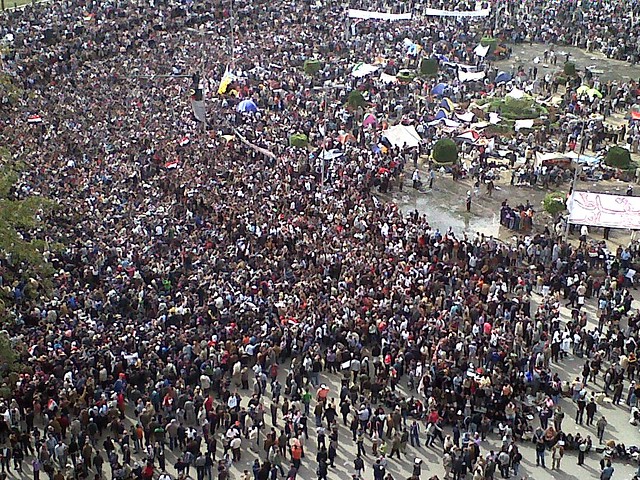
The political demonstrations that began in Tunisia and spread to Egypt and to other countries in the region, appear to have instilled a new sense of possibility, solidarity and optimism in large parts of the world—citizens might be able shape their history after all. This also poses many questions that need discussing, for instance, the role of the public realm (Tahrir Square), the role of social media and of citizens, local and across the other side of the world—and our role.
Are we witnessing a new stage of political evolution? And if this is the case, what is our responsibility as professionals? To what degree has the social and public space facilitated these events? And, are these special types of public spaces? What are the characteristics of, say, Tahrir Square, that could assist public civic expression?
SANTIAGO, CHILE
21 November 2010
Calle Dieciocho is located close to the centre of Santiago, Chile, in an area of historical and architectural value. However, unlike other streets close by, such as,
República and
Avenida Brasil,
calle Dieciocho has not received a similar level of attention or recognition.
Sadly, important historical areas of Santiago, such as this, were badly damaged during the February 26, 2010 earthquake. In some cases, only the façade of some of these buildings stand as testimony of their architectural value.
Calle Dieciocho (en sepia) from
beatriz maturana on
Vimeo.
Modelos de desarrollo urbano y paisaje se abordarán en charlas convocadas en la U. Central
Source: Seconstruye.com
Se trata de encuentros abiertos y gratuitos dirigidos a estudiantes y docentes relacionadas con la arquitectura y disciplinas afines.
Dos actividades de conversación con expertos invitados se han programado para el miércoles 24 de noviembre en la Facultad de Arquitectura, urbanismo y Paisaje de la Universidad Central de Chile. La primera de éstas partirá a las 09.00 con “Evaluación y Panel. Modelos de Desarrollo y Proyecto Urbano”, organizado por el taller Urbanismo V de Escuela de Arquitectura, dirigido por el docente y geógrafo Ricardo Jordán y el ayudante Daniel González.
Find the article
here.
"XVII Bienal de Arquitectura: 8.8 RE-CONSTRUCCIÓN"
Reports Beatriz C. Maturana
After the 8.8 earthquake that hit Chile in February 27—a year in which Chile celebrates it bicentenary of independence—this biennale is not surprisingly characterized by a focus on reconstruction projects; among them, housing, public buildings, and infrastructure. In spite of the enormous reconstruction task, the overall mood of the display is optimistic and confident.
Many of these projects are proposals by various faculties of architecture located in cities representing the most devastated areas. Thus, often these projects are located in small coastal and country towns that would have seldom been featured at earlier biennales. This is one of the many important aspects of this biennale worth carrying into the future.