23.8.12

Cool people

One thousand ice figures
An installation by artist Nélle Azevedo
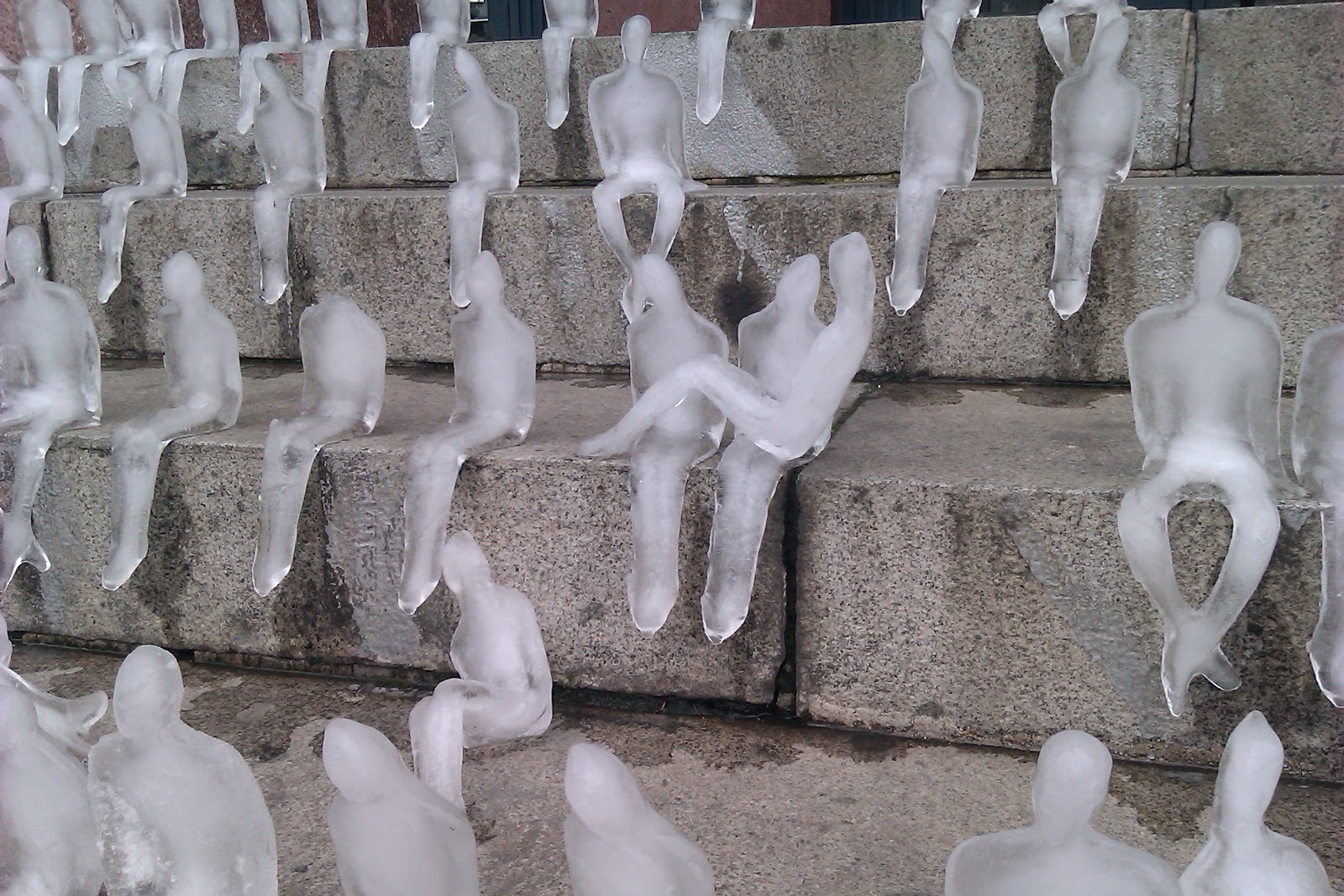
This exhibition/installation was displayed today (22.08.12) at the Faculty of Law (Facultad de Derecho), University of Chile in Santiago. The work symbolising global warming, marks the inauguration of the VI Jornadas de Derecho Ambiental (VI Environmental Rights Conference) and has been exhibited already in France, Italy, Portugal, Cuba, Germany and Japan.

19.5.12

TEST 27F: Observatorio Reconstrucción [OR] Conference

Until 2010, when Observatorio Reconstrucción (OR) University of Chile was established, there had been no national experience of a centralized academic space to collect, discuss and evaluate the reconstruction process. I have just attended a conference organised by OR. The conference, TEST27F, dealt with a wide range of aspects affecting people after a disaster, in this case Feb27, 2010 (the Chilean 8.8 earthquake).

The conference topics were varied and addressed issues such as policy development and implementation and discussed propositions, such as that by Prof Hugo Romero, who claimed that these types of disasters are not necessarily natural. He stated that the designed inequity of our cities (also in rural areas) determines who is going to be affected by these disasters. We are all familiar with Prof Romero’s position; however, he presented the evidence to support this. For instance,   an aerial image of Dichato (a zone completely devastated by the tsunami) showed that the northern well-to-do and well-designed neighbour town was not affected. A partly topographic issue, partly a design issue and mostly about who has the means to decide where and how to live.

3.4.12

Adapting to our own mistakes--are you serious?

This is in response to an article published in The Conversation, entitled “We can’t prevent climate change, so what should we do?” (see below), an article that suggests that it is perhaps time to give up on climate change prevention and move towards adaptation.

The article in question makes what I would call crude assumptions, among them is the claim that we have, for the last 30 years, tried to ‘prevent’ climate change, “Prevention is no longer an option”, it asserts. But, before we exchange prevention for adaptation should not we ask whether our governments have seriously worked toward prevention?

If Australia takes no action by 2020 our carbon pollution could be 20 per cent higher than in 2000, not 5 to 25 per cent lower as the Australian Government intends. [1]
Symptomatic of the lack of efforts is that many of our politicians (embarrassingly recent) and sections of the public still do not believe that climate change is largely human induced. Surely we can address and analyse how our governments, themselves ‘governed’ by the market, have failed to comply with the minimum demands as set by international agreements in the struggle to curb climate change.

Efforts to prevent climate change have and are still feeble gestures designed to fall short and deaf to the concerns of the community. And, this is the case in the so called developed world that not only bears the highest level of responsibility for CO2 emissions, but that also has the potential and resources to do something about.
Punta Arenas, Chile. Image by Omar García. El Mercurio on Line. [2] 
Tallygaroopna, Australia. Image by Simon O'Dwyer Read. The Age. [2]

9.1.12

A hospital with an attitude: the new Royal Children Hospital in Melbourne, Australia

I recently visited the new building for Royal Children Hospital in Melbourne, Australia which, as I hope these images capture, manages to successfully create a friendly and stimulating environment for children.

Hospital's main façade


     Copyright © beatriz.maturana 2003-