Reflections on the Oxford Conference 2008
This article discusses ‘The Oxford Conference 2008: 50 Years on – Resetting the Agenda for Architectural Education’ aimed to influence architectural education. With delegates from forty-two countries representing every continent there was a manifest change in the composition of the delegates as compared to 50 years ago. On the face of it this would suggest that a more diverse attendance made a difference in the spectrum of issues coming to the forefront: but did it?
Resetting agendas: a conference in a climate of change
This article was first published by Cambridge Journals, ARQ. How to cite the article: Beatriz Maturana (2008). Resetting agendas a conference in a climate of change.
Architectural Research Quarterly, 12, pp 209-212 doi:10.1017/S1359135508001127
The original article can be downloaded from:
Architectural Research Quarterly
I thought I should share this confession of my errors, a realisation triggered when watching "Obama speaks out about bin Laden raid", http://www.abc.net.au/news/video/2011/05/09/3211956.htm. 7pm ABC TV News NSW, Monday, May 9, 2011.
I am sorry President Obama, so sorry.[1] I belonged to the group of “anyone who would question” your assassination.[2] My questions were different to yours, so sorry—that was my mistake based on an erroneous notion of democracy. You see, I come from a country that was at the receiving end of the USA government policies (Chile 1973-1990) and we thought that we had to ask questions, which happened to be different to those asked by Pinochet and the USA. Just imagine! Pinochet also executed people without a trial (although he didn’t admit to it) and we thought that
he was evil and we went and struggled for the return to the rule of law and democracy! The funny thing is that we believed that we had succeeded—how wrong we were. We really live in weird times.
By Beatriz C. Maturana
According to the words of the Pritzker Prize jury, in the 80’s and at the height of post-modernism, Souto de Moura's buildings were “intensely out of fashion”.[1] Souto de Moura deliberately did not give in to the pressure to conform to architectural fashion or fads. Working with and within his own architectural national context has provided Souto de Moura with an abundance of meaningful references to build upon. The jury referred to Souto de Moura’s architectural work in terms of the “echoes of architectural traditions”, “mindful of its context” that reinforces history while, “expanding the range of contemporary expression”.[1] His most challenging, innovative and unconventional trait is that Souto de Moura’s architecture is bravely local.
 |
| Braga Municipal Stadium. Photograph by Luís Ferreira Alves. Image source: The Pritzker Architecture Prize. © The Hyatt Foundation |
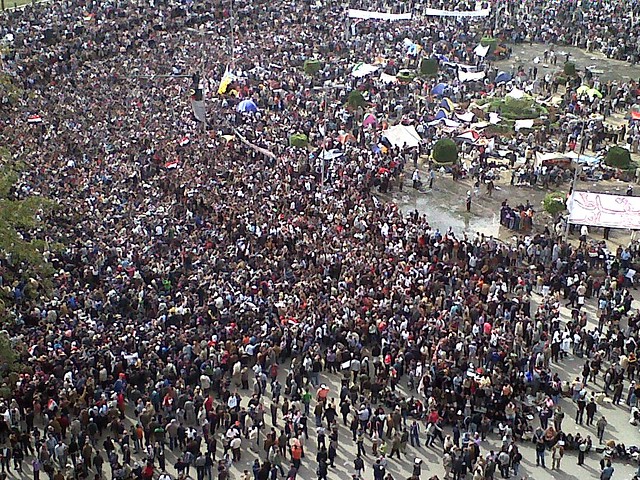
The political demonstrations that began in Tunisia and spread to Egypt and to other countries in the region, appear to have instilled a new sense of possibility, solidarity and optimism in large parts of the world—citizens might be able shape their history after all. This also poses many questions that need discussing, for instance, the role of the public realm (Tahrir Square), the role of social media and of citizens, local and across the other side of the world—and our role.
Are we witnessing a new stage of political evolution? And if this is the case, what is our responsibility as professionals? To what degree has the social and public space facilitated these events? And, are these special types of public spaces? What are the characteristics of, say, Tahrir Square, that could assist public civic expression?